

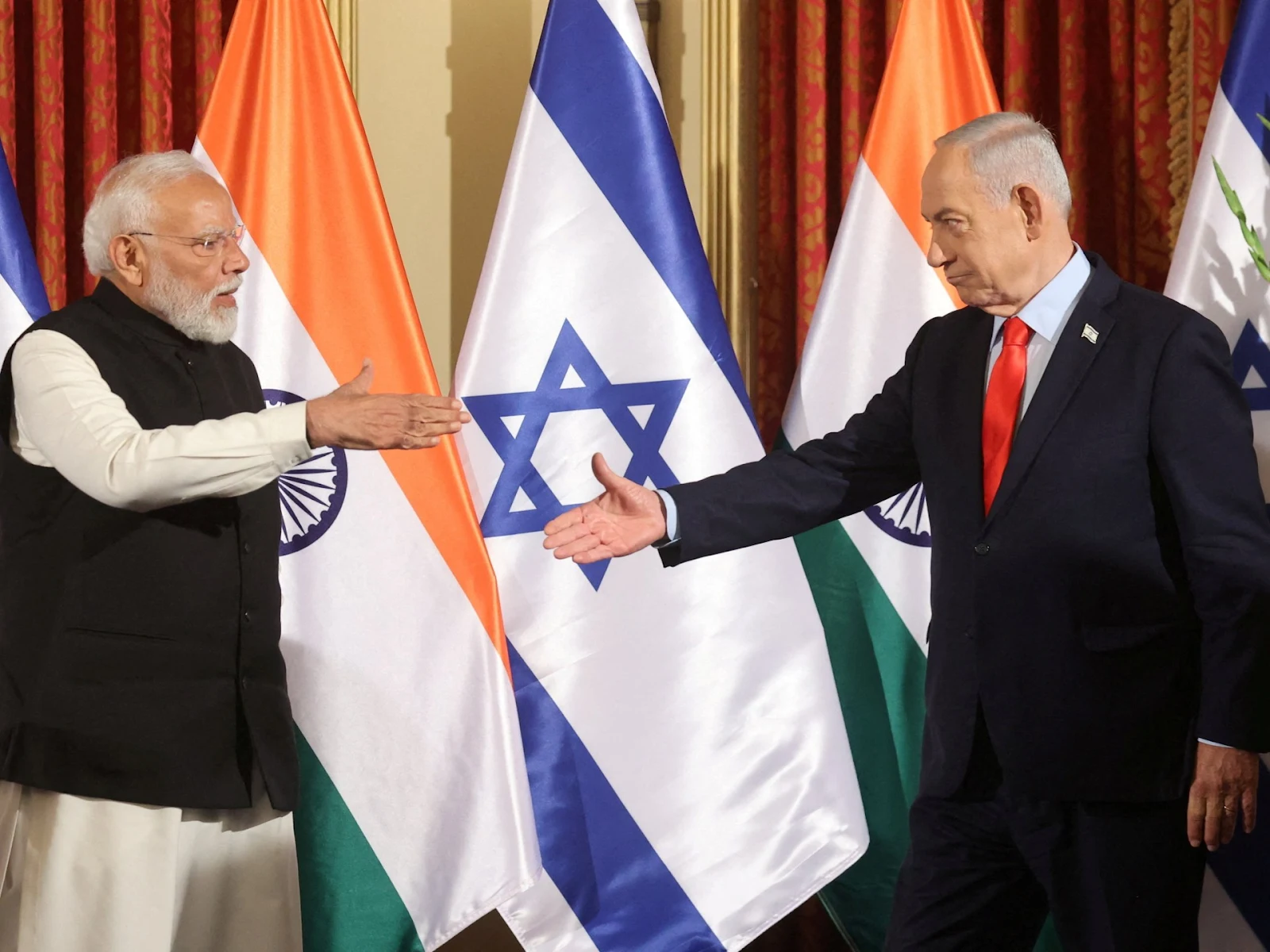
Indian Prime Minister Narendra Modi and his Israeli counterpart Benjamin Netanyahu announced plans to strengthen cooperation on defence technology and pursue a free trade agreement, as Modi concluded a two-day visit to Israel.
The announcement came during a joint news conference in Jerusalem, where the two leaders also highlighted cooperation in areas such as artificial intelligence and cybersecurity, with more than a dozen bilateral agreements signed.
Netanyahu stated, “The future belongs to those who innovate and Israel and India are bent on innovation. We’re proud ancient civilisations, very proud of our past. But absolutely determined to seize the future, and we can do it better together.”
A joint statement outlined cooperation in “horizon scanning”, a mechanism to identify emerging global trends in areas like technology, economy, and society, by leveraging data.
Israel also agreed to allow an additional 50,000 Indian nationals into the country, where many South Asians have filled construction and caregiving jobs since restrictions were placed on Palestinian workers at the start of Israel’s war on Gaza.
Regional Context
Modi’s visit, his second since taking office in 2014, has drawn criticism at home, amidst ongoing tensions over Israel’s war against Palestinians in Gaza, which has killed over 72,000 people.
The joint statement referenced the Hamas-led attack on Israel on October 7, 2023, and an April 2025 attack on tourists and civilians in Pahalgam, in Indian-controlled Kashmir.
Modi said, “Terrorism cannot be accepted in any form or expression,” while also historically supporting the establishment of a Palestinian state, although sometimes abstaining from criticism of Israel in international forums.
Earlier this month, India condemned Israeli measures to deepen its control over the occupied West Bank, while both countries lauded United States President Donald Trump’s plan to advance the ceasefire in the Gaza Strip.
Source: Al Jazeera
