

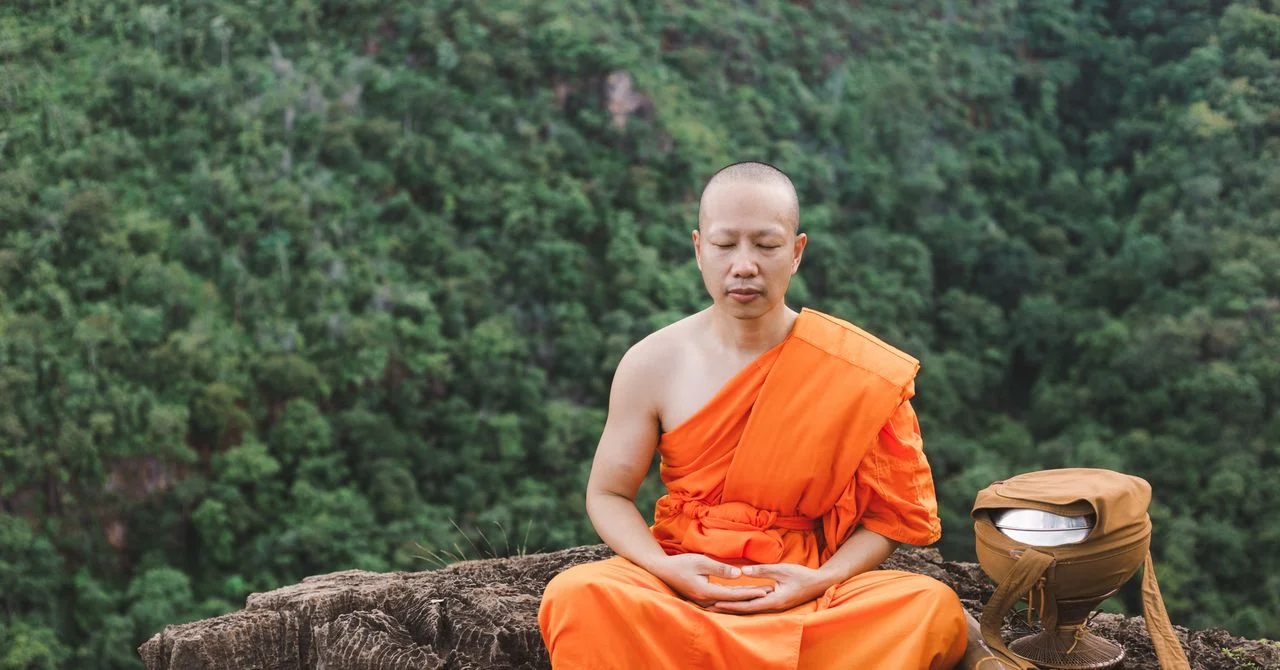
A new international study has shed light on the neural dynamics of meditation, revealing that this ancient practice is not a state of rest, but rather a state of heightened cerebral activity. Researchers from the University of Montreal and Italy’s National Research Council used magnetoencephalography (MEG) to analyze the brain activity of 12 monks of the Thai Forest Tradition at Santacittārāma, a Buddhist monastery outside Rome.
The study focused on two classical forms of meditation: Samatha and Vipassana. Samatha is a technique that focuses on sustained attention to a specific objective, often steady breathing, with the aim of stabilizing the mind and reaching a deep state of calm and concentration. Vipassana, on the other hand, is based on equanimous observation of sensations, thoughts, and emotions as they arise in order to develop mental clarity and a deeper understanding of the experience. As Karim Jerbi, professor of psychology at the University of Montreal and one of the study’s coauthors, explains, “With Samatha, you narrow your field of attention, somewhat like narrowing the beam of a flashlight; with Vipassana, on the contrary, you widen the beam.”
Inside the Meditating Brain
The researchers recorded multiple indicators of brain dynamics, including neural oscillations, measures of signal complexity, and parameters related to “criticality,” a concept borrowed from statistical physics that has been applied to neuroscience for 20 years. Criticality describes systems that operate efficiently on the border between order and chaos, and in neuroscience, it is considered a state optimal for processing information in a healthy brain. According to Jerbi, “A brain that lacks flexibility adapts poorly, while too much chaos can lead to malfunction, as in epilepsy. At the critical point, neural networks are stable enough to transmit information reliably, yet flexible enough to adapt quickly to new situations.”
The Infrastructure of Neural Complexity
During the experiment, the monks’ brain activity was recorded by a high-resolution MEG system as they alternated from one type of meditation to the other with brief periods of rest in between. The data were then processed with advanced signal analysis and machine learning tools to extract different indicators of neural complexity and dynamics. Results published in the journal Neuroscience of Consciousness show both forms of meditation increase the complexity of brain signals compared to a brain at rest. This finding suggests the brain in meditation does not simply calm down but rather enters a dynamic state rich with information.
The study’s findings have significant implications for our understanding of the neural mechanisms underlying meditation. As Jerbi notes, “Since meditation is an active state that engages attentional processes, it affects several aspects of brain function, leading to improved well-being and a reduction in stress and symptoms of anxiety and depression.” By analyzing the ancient practice of meditation with cutting-edge technology, the study sheds new light on a thousand-year-old tradition, revealing the complex neural dynamics that underlie this powerful practice.
