

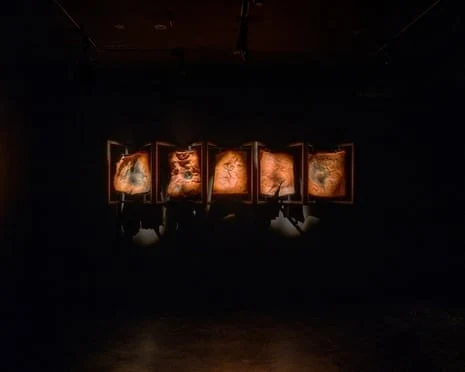
The Second World War left an indelible mark on the world, with its impact still felt today. For Japanese-American artist Jacqueline Kiyomi Gork, the war holds a personal significance, as her great-uncle was stationed on the island of Okinawa as a US soldier, while his family was incarcerated in a Japanese internment camp in California. This complex and tumultuous period in history has inspired Gork's latest exhibition, Gama 1213-B, a sound installation that emulates the spaces of the war, including a Japanese internment camp in California and the caves used as bunkers in Okinawa.
Gork's great-uncle, a Japanese-American soldier, was one of the few who spoke Japanese, and he worked to ensure the safe passage of the local Uchinanchu people who took refuge in the caves. However, the caves were also sites of mass suicide, as Japanese soldiers instructed the Uchinanchu to kill themselves rather than face the US army. This tragic history has been largely silenced, and Gork's exhibition aims to uncover and honor the memories of those who suffered. As reported by The Guardian, the Japanese internment camps in California, such as Tule Lake, have been the subject of much controversy and debate.
The exhibition, which will be on show at Canary Test in Los Angeles, features a sculptural work and an ambisonic sound piece that recreate the silence and stillness of the caves and the internment camp. Gork has used clay sourced from the caves in Okinawa to recreate sections of the cave walls as large ceramic tiles, which are inset within a gridded, metal folding screen. This installation mimics the sonic effect of the cave's multifaceted surface, where echoes and reverberations are deadened. The ambisonic sound piece, on the other hand, recreates the sounds of the wind and the open air at Tule Lake, which is now an airplane field with little acknowledgment of its past.
Exploring the Intersection of Sound and Memory
Gork's work is a departure from her usual modality, which often involves creating feedback loops that enhance the sound of the viewers' movements in the exhibition space. Instead, Gama 1213-B is more about letting the sound happen around the viewer, creating a sense of stillness and contemplation. The exhibition is titled after the Uchinaaguchi word for cave (gama) and the number of her grandfather's barrack at Tule Lake (1213-B), and it features a selection of books from Gork's research and her grandparents' collection.
Gork's journey to create this exhibition began when she visited the caves of Okinawa, where she found herself listening to the sound of water trickling through the space. This experience prompted her to consider how her perspective of the space, informed by her family's history and the war, changed her relationship to the sound of water, which is often comforting but can also be menacing and unnerving. The exhibition is an attempt to honor the charged, intentional, and yet uncontrollable silences of these sites, and to explore the intersection of sound and memory.
A Personal and Historical Narrative
Gork's exhibition is also a personal narrative, one that explores her own Japanese-American and Uchinanchu roots. The line of inquiry into her heritage, exemplified by this exhibition, is an unfinished and potentially endless project, one that is more about the unknown than anything else. Gork describes it as being about being OK with not knowing, or being OK with the fact that there is a huge silence, and honoring that. The exhibition is a time-based work, one that requires the viewer to spend time with it, almost like a meditation, to sit with and acknowledge what happened.
Gork's great-uncle's story, and the stories of those who were incarcerated in the internment camps, are a testament to the complexities and challenges of war. The exhibition Gama 1213-B is a powerful sonic memorial that remembers the dead and honors the silence of those who suffered. As Gork says, it's through time that we can connect with the unknown, and it's through spending time with this exhibition that we can begin to understand the complexities of the past.
Gama 1213-B will be on show from 12 February to 20 March at Canary Test in Los Angeles, providing a unique opportunity for viewers to engage with this important and thought-provoking exhibition.
