

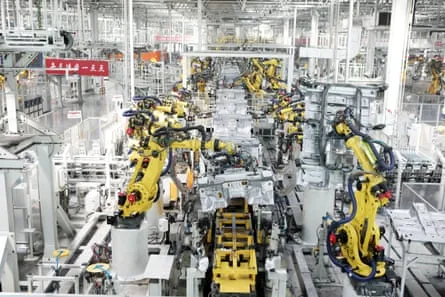
As I visited 11 companies in five Chinese cities, I began to grasp the scope of China's robotics revolution. The country is pouring vast resources into achieving a sci-fi vision of autonomous humanoid robots, with the potential to revolutionize the world of work.
At the forefront of this revolution is Chen Liang, the founder of Guchi Robotics, an automation company headquartered in Shanghai. Chen's goal is to eliminate as many workers in car factories as technologically possible, and his company has made significant strides in automating the final assembly process. However, he estimates that 80% of the final assembly still has yet to be automated.
The technology behind China's current robotics boom is deep learning, which has the potential to allow machines to operate in unfamiliar and fluid environments. Many researchers believe that machines can learn to navigate the physical world in the same way that large language models like ChatGPT learn to navigate language.
China's Robotics Landscape
The Chinese government has announced a £100bn fund for strategic technologies, including robotics, and major cities have invested their own resources into robotics projects. There are now roughly 140 Chinese firms hoping to build humanoids, with some of the frontrunners making their debut at the lunar new year festival gala.
One of these companies is Galbot, a startup that has pursued a less showy strategy than many of its competitors. Galbot's robots are already deployed in several Chinese car factories, performing mundane tasks such as picking up items and setting them down safely and reliably.
I visited Galbot's headquarters in Beijing, where I met with Chen Liang, who was there to discuss a potential partnership. The company's founder, Wang He, aims to have 10,000 robots handling basic retail and factory work in three years.
Teleoperations and the Future of Work
Teleoperations, the process of training robots to perform tasks, is becoming increasingly important in the development of humanoid robots. Companies like Leju Robotics are using teleoperations to train their robots, with workers performing tasks such as wiping down a table or moving a glass of water.
These workers, often hired through labour dispatch companies, are part of a largely invisible network that underwrites China's economy. They are typically paid around 6,000 to 10,000 yuan a month, similar to full-time delivery drivers, but with better hours.
Ulrik Hansen, the co-founder of Encord, a data services company, believes that teleoperations are on the verge of a huge boom. He argues that teleoperations are the "new manufacturing job," but acknowledges that the vast majority of workers will not end up managing robots.
China's Robotics Industry and the Role of Government
The Chinese government has played a significant role in promoting the development of the robotics industry. President Xi Jinping has abandoned the language of "market-driven" innovation in favour of the Chinese Communist party's "unified leadership" in setting technology priorities.
Local governments have become more responsive and competitive in satisfying the centre, with cities like Shenzhen and Hefei providing support for startups and establishing training centres. The Leju facility, for example, was provided to the company by the district government as part of a joint venture agreement.
Viktor Wang, the co-founder of PsiBot, a startup that specialises in making dexterous robotic hands, has received multiple unsolicited offers from municipal governments eager to help him establish training centres.
The Future of Automation and the Displacement of Human Labour
Chen Liang believes that much of the assembly work in factories will be close to fully automated by the mid-2030s. He views the displacement of human labour with detachment, seeing it as an inevitable consequence of technological progress.
However, the social consequences of this displacement are significant. There are 120 million workers in Chinese factories today, and many of them will need to change careers as automation takes hold. Chen acknowledges that his company has discussed contingency plans for laid-off workers, but the details are unclear.
As China's robotics revolution continues to gather pace, it is clear that the country is on the cusp of a significant transformation. The question is, what will this mean for the future of work, and how will the government and industry leaders address the challenges that come with it?
