

As the world hurtles towards a future where artificial intelligence and robotics converge, China is at the forefront of this revolution, with a plethora of companies working tirelessly to develop autonomous humanoid robots. The country's robotics industry has witnessed an unprecedented boom, with significant investments pouring in from both the government and private sectors.
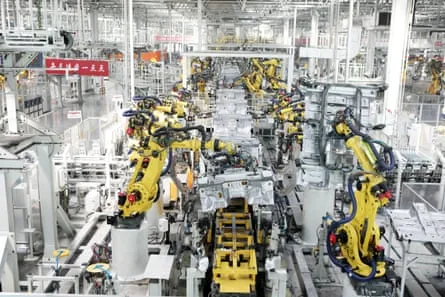
At the heart of this revolution is Chen Liang, the founder of Guchi Robotics, a company that specializes in creating machines that can install wheels, dashboards, and windows for top Chinese car brands, including BYD and Nio. Chen's vision is to eliminate as many workers in car factories as technologically possible, and his company has already made significant strides in achieving this goal.
One of the key technologies driving this revolution is deep learning, a mathematical engine that enables machines to learn by discerning patterns from vast datasets. This technology has the potential to revolutionize the world of work, with many researchers believing that machines can learn to navigate the physical world in the same way that humans do.
China's Robotics Boom
The Chinese government has announced a £100bn fund for strategic technologies, including robotics, and many cities have invested their own resources into robotics projects. This has led to the emergence of numerous Chinese firms hoping to build humanoids, with some of the frontrunners making their debut at the lunar new year festival gala.
Companies like Galbot, a humanoid robotics startup, are working to develop robots that can perform mundane tasks such as picking up items and setting them down elsewhere safely and reliably. The founder, Wang He, aims to have 10,000 robots handling basic retail and factory work in three years.
Another notable company is Unitree, which shipped over 5,500 humanoid robots last year, more than any company in the world. Their robots have been used in various applications, including as backup dancers for a Chinese pop star and as robot dogs navigating live street traffic for deliveries.
The Future of Work
The rise of autonomous humanoid robots raises important questions about the future of work. While some experts believe that these robots will displace human workers, others argue that they will create new job opportunities in fields such as robot maintenance and programming.
Chen Liang, for instance, believes that the onrush of technology is inevitable and that it will lead to the displacement of human labor. However, he also acknowledges that this will require significant adjustments, including the retraining of workers to work alongside robots.
As the world grapples with the implications of this revolution, it is clear that China will play a significant role in shaping the future of work. With its vast investments in robotics and artificial intelligence, the country is poised to become a leader in the development of autonomous humanoid robots.
Teleoperations: The New Manufacturing Job
One of the key areas of innovation in the robotics industry is teleoperations, which involves the remote control of robots. This technology has the potential to create new job opportunities in fields such as robot training and maintenance.
Companies like Encord, a data services company based in Silicon Valley, are working to develop teleoperations platforms that enable humans to control robots remotely. According to Ulrik Hansen, the co-founder of Encord, teleoperations is on the verge of a huge boom, with the potential to create thousands of new jobs in the coming years.
However, the work of teleoperators can be dehumanizing, with workers often performing repetitive tasks for hours on end. As the industry continues to evolve, it is essential to consider the social consequences of this technology and ensure that workers are treated fairly and with dignity.
Conclusion
China's robotics revolution is a testament to the country's commitment to innovation and technological advancement. As the world continues to grapple with the implications of this revolution, it is clear that China will play a significant role in shaping the future of work.
With its vast investments in robotics and artificial intelligence, the country is poised to become a leader in the development of autonomous humanoid robots. However, it is essential to consider the social consequences of this technology and ensure that workers are treated fairly and with dignity.
