

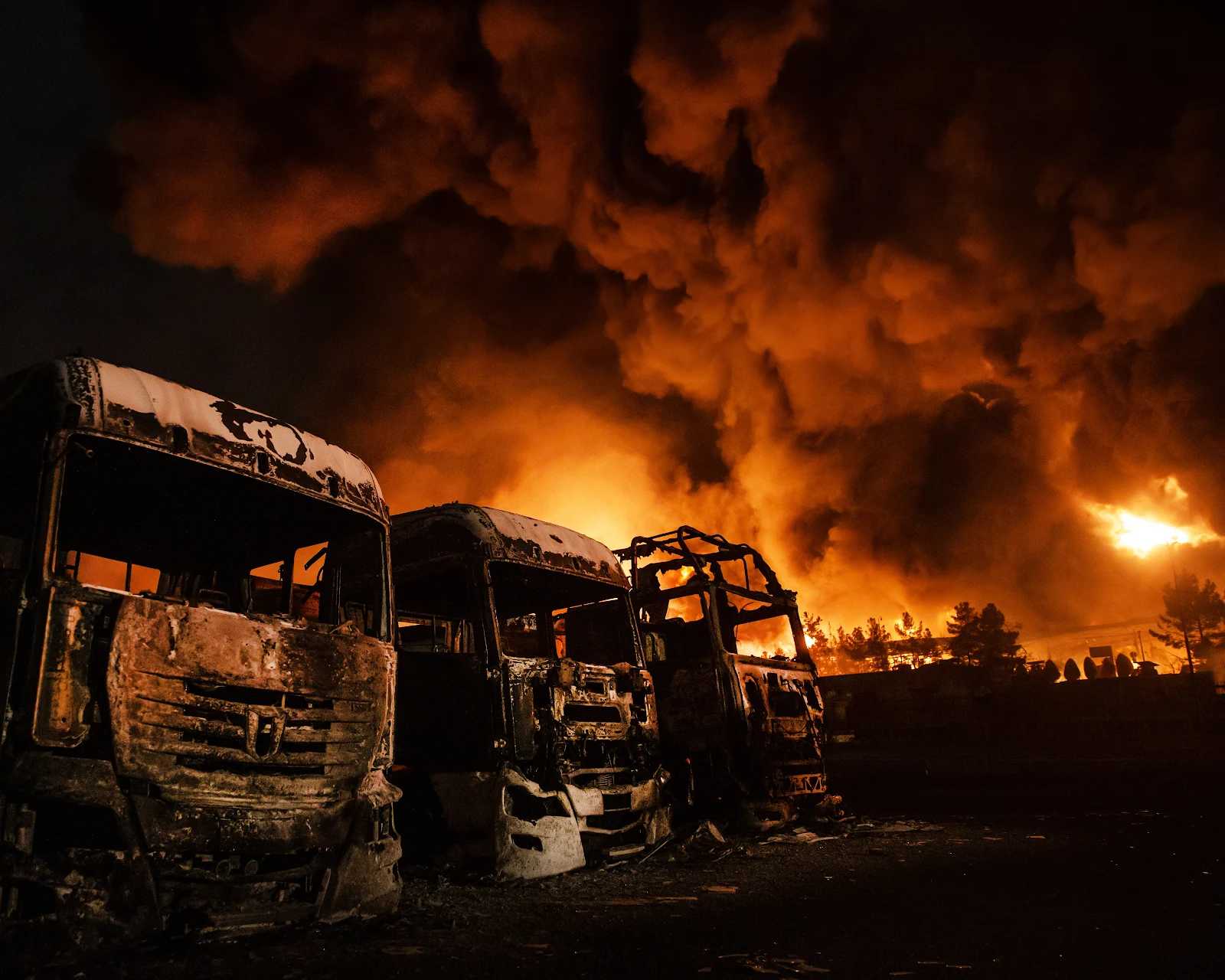
The ongoing conflict between the US, Israel, and Iran has sparked a significant surge in oil prices, with Brent crude climbing above $100 a barrel for the first time since 2022. As reported by The Guardian, this development has led to a fresh stock market sell-off, with investors increasingly concerned about the potential consequences of a sustained supply crunch. The situation has been exacerbated by a weekend of escalating violence in the Middle East, which has prompted accounts of 'apocalyptic' scenes in the Iranian capital.
The impact of the conflict on global energy markets has been severe, with at least five energy sites in and around Tehran hit by airstrikes. Kuwait's national oil company has announced a precautionary production cut amid retaliatory attacks by Iran, further contributing to the supply crisis. The strait of Hormuz, a critical trade artery through which a significant portion of global oil and seaborne gas tankers pass, has effectively been closed for a week.
According to Donald Trump, the rise in energy prices is 'a very small price to pay' for the US 'and World, Safety and Peace'. However, the Iranian regime has warned that US-Israeli strikes risk pushing prices even higher, with a spokesperson for the country's Revolutionary Guard Corps stating that if the game continues, oil prices could rise to over $200 per barrel.
Global Market Fallout
The surge in oil prices has had a significant impact on global markets, with stock markets across Europe falling on Monday. The UK's FTSE 100 index dropped 1%, while the German Dax and French Cac 40 fell by 1.2% and 1.8%, respectively. The Stoxx Europe 600, which tracks the biggest companies across the continent, fell by 1.3%, erasing all of its gains in the year so far.
On Wall Street, the Dow Jones, S&P 500, and tech-focused Nasdaq all fell about 1% at the open. Japan's Nikkei 225 dropped 5% on Monday, while South Korea's Kospi slumped 6.6%. Australia's ASX 200 finished a volatile day of trading down 2.9%. The state-run Bahrain News Agency announced that the country's state oil company had declared force majeure for its shipments after an Iranian attack set its refinery ablaze.
Expert Analysis
Clayton Seigle, a senior fellow at the Center for Strategic and International Studies, noted that the 'grace period given by the market to the Trump administration expired at the end of last week'. Seigle stated that a deficit of 20m barrels per day is hitting global oil market balances with no sign of relief, and that President Trump's demand for unconditional surrender is 'a very unlikely prospect'.
The US energy secretary, Chris Wright, has attempted to reassure investors that the recent disruption within the oil and gas industries will not last long. However, such statements appear to have been ignored, with oil prices rocketing by two-thirds from just above $60 a barrel at the start of the year. Fears of a global oil shortfall have been compounded by Qatar's energy minister, who predicted that if the war continues unabated, all Gulf energy exporters will be forced to shut down production within weeks, and oil will rise to $150 a barrel.
Regional Responses
Oil storage facilities in Saudi Arabia, the United Arab Emirates, and Kuwait are reaching their limits, meaning large oilfields may need to be shut down if crude cannot be exported via the strait of Hormuz to the global market. Hundreds of tankers attempting to transit the strait have come to a halt after the IRGC threatened to 'set ablaze' any vessel using the trade route.
Across Asia, countries are scrambling to mitigate a supply crisis. South Korea announced a cap on domestic fuel prices for the first time in nearly 30 years, with President Lee Jae Myung stating that the current crisis 'is a significant burden on our economy'. Bangladesh announced plans to close all universities from Monday, bringing forward the Eid al-Fitr holidays as part of an emergency bid to conserve electricity and fuel.
The White House has suggested countermeasures such as rerouting Saudi oil via the Red Sea, drawing on emergency US crude reserves, or extending government-backed insurance to shipping companies. However, Seigle noted that this would not be enough to offset the loss of 20m barrels of oil a day 'or anywhere in that ballpark'.
