

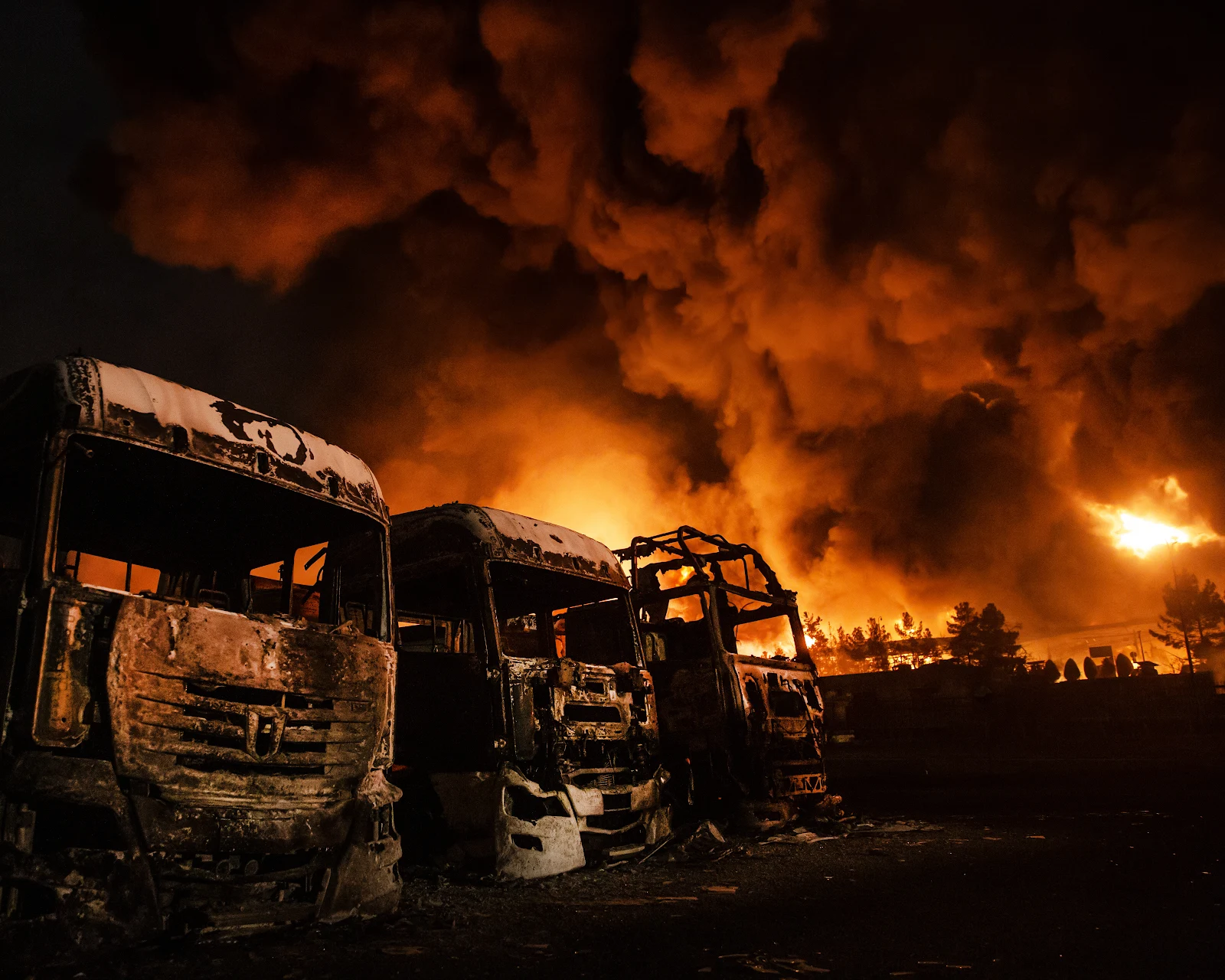
The recent escalation of violence in the Middle East has sent shockwaves through global markets, with oil prices surging to their highest level in four years. As reported by The Guardian, the conflict between the US, Israel, and Iran has triggered a sustained supply crunch, prompting concerns about the potential for a global economic fallout.
According to a report by CBS News, US President Donald Trump stated that the US-Israel war with Iran is 'very complete,' which led to a significant decrease in oil prices. The Dow closed at a 230-point jump, while the S&P and Nasdaq closed at 0.83% and 1.38% up, respectively.
Earlier in the day, oil prices had reached a four-year high, with Brent crude climbing as high as $119.50 (£89.40) a barrel. The increase was largely driven by the escalating violence in the Middle East, which has intensified concerns around a sustained supply crunch. The strait of Hormuz, one of the world's most important trade arteries, has been effectively closed for a week, further exacerbating the crisis.
Oil Price Volatility
The volatility in oil prices has been unprecedented, with Brent crude dropping to $85 a barrel after reports that finance ministers from the G7 group of developed economies would discuss a possible joint release of petroleum from reserves. The West Texas Intermediate (WTI) benchmark price of US crude also dropped, going down to $86 a barrel after rising to $103 a barrel earlier in the day.
Clayton Seigle, a senior fellow at the Center for Strategic and International Studies, noted that the 'grace period given by the market to the Trump administration expired at the end of last week.' He added that 'a deficit of 20m barrels per day is hitting global [oil market] balances with no sign of relief.'
The Trump administration has attempted to reassure investors that the recent disruption within the oil and gas industries will not last long. However, such statements appear to have been ignored, with oil prices rocketing by two-thirds from just above $60 a barrel at the start of the year.
Global Economic Fallout
The global economic fallout from the crisis is already being felt, with stock markets across Europe falling on Monday. The UK's blue-chip FTSE 100 index was down 1%, while the German Dax dropped by 1.2%. The French Cac 40 was down 1.8%, and the Stoxx Europe 600, which tracks the biggest companies across the continent, fell by 1.3%.
Japan's Nikkei 225 dropped 5% on Monday, while South Korea's Kospi slumped 6.6%. Australia's ASX 200 finished a volatile day of trading down 2.9%. The crisis has also prompted countries to take emergency measures to mitigate the impact of the supply crunch.
South Korea announced a cap on domestic fuel prices for the first time in nearly 30 years, with President Lee Jae Myung stating that the current crisis 'is a significant burden on our economy.' Bangladesh announced plans to close all universities from Monday, bringing forward the Eid al-Fitr holidays as part of an emergency bid to conserve electricity and fuel.
Energy Security Concerns
The crisis has highlighted concerns about energy security, particularly in Asia, which is heavily reliant on energy imports from the Middle East. Hundreds of tankers attempting to transit the strait of Hormuz have come to a halt after the IRGC threatened to 'set ablaze' any vessel using the trade route.
The White House has suggested countermeasures such as rerouting Saudi oil via the Red Sea, drawing on emergency US crude reserves, or extending government-backed insurance to shipping companies. However, experts such as Seigle argue that these measures will not be enough to offset the loss of 20m barrels of oil a day.
As the crisis continues to unfold, it remains to be seen how the global economy will be impacted. One thing is certain, however: the volatility in oil prices will have far-reaching consequences for economies around the world.
Regional Implications
The regional implications of the crisis are already being felt, with countries such as Qatar predicting that if the war continues unabated, all Gulf energy exporters will be forced to shut down production within weeks, leading to a potential oil price of $150 a barrel.
Oil storage facilities in Saudi Arabia, the United Arab Emirates, and Kuwait are reaching their limits, meaning large oilfields may need to be shut down if crude cannot be exported via the strait of Hormuz to the global market. The situation remains precarious, with the potential for further escalation and economic disruption.
