

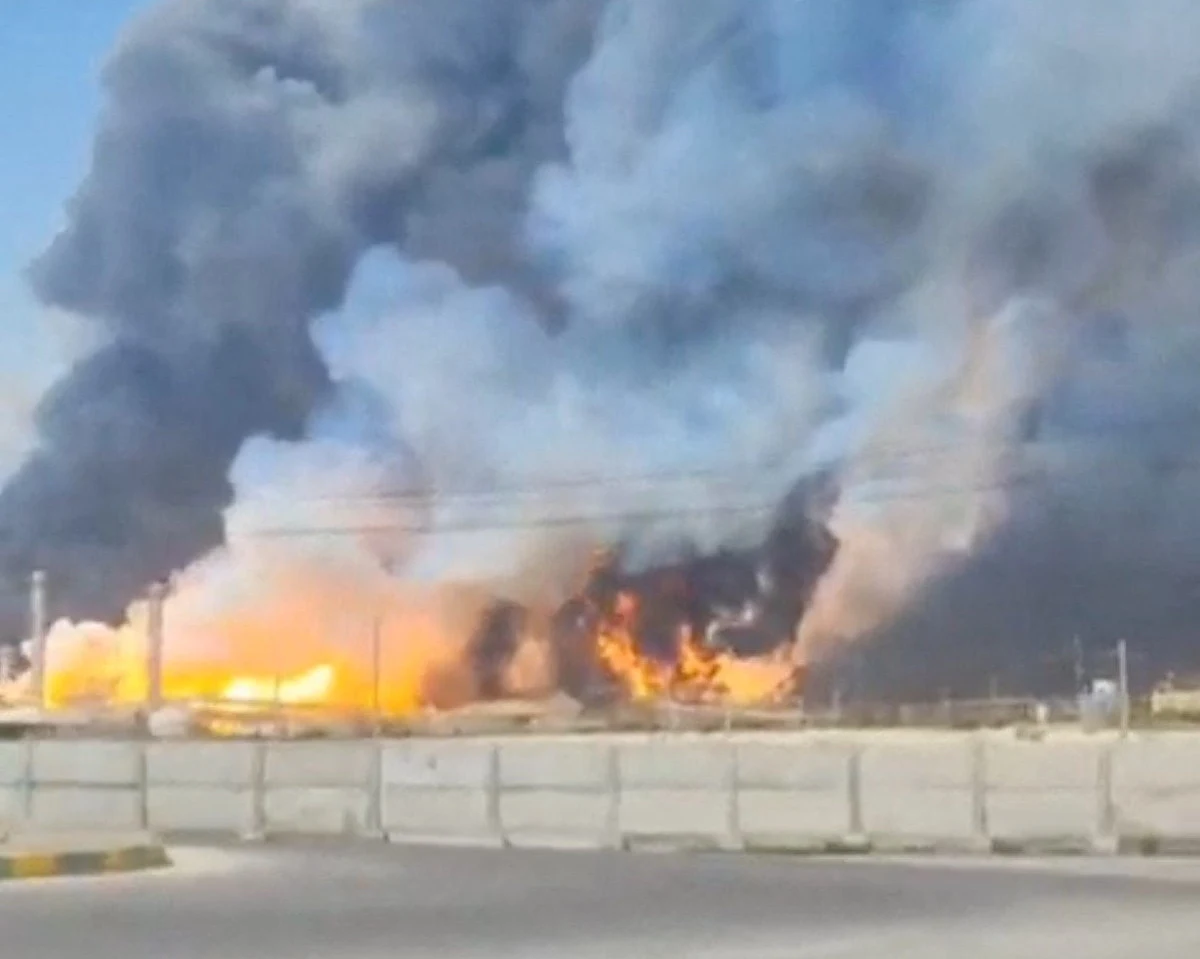
The ongoing conflict between Iran and Israel has led to a significant escalation in attacks on gasfields, resulting in a surge in oil and gas prices worldwide. As reported by The Guardian, the situation has sparked fears of a prolonged disruption to international energy supplies. State-run QatarEnergy has confirmed that an Iranian attack on its facilities has wiped out 17% of its liquefied natural gas (LNG) export capacity, which is expected to take three to five years to repair.
According to QatarEnergy, the damage to its facilities has been extensive, with the Ras Laffan gasfield, the world's largest LNG facility, being a key target. The energy consultancy Wood Mackenzie has stated that the attacks on Qatar's LNG hub have fundamentally altered the global gas market outlook, with initial expectations of a two-month disruption now likely to be exceeded. Each additional month of disruption removes about 1.5% from annual global LNG availability.
The impact of the conflict on the global energy market has been significant, with Brent crude rising by 10% to $119 a barrel at one point before slipping back to $110 a barrel. European gas prices have also jumped, with the Dutch wholesale gas price up 24% at €68 a megawatt hour. UK gas prices have more than doubled since late February, and are likely to drive up household bills.
Global Market Reactions
The escalation of the war and its effect on oil and gas prices has triggered a sharp sell-off across stock markets. Japan's Nikkei tumbled 3.4%, South Korea's Kospi fell 2.7%, and Hong Kong's Hang Seng was down 2%. European markets followed Asia, with the UK's FTSE 100 down nearly 3% by early afternoon before closing down 2.35% at 10,063 points.
Experts have warned of the potential consequences of the conflict on the global economy. Susannah Streeter, the chief investment strategist at the broker Wealth Club, said: "Fears of a sustained energy shock have resurfaced after the escalation in the Iran war sent oil and gas prices soaring. The prospect of a longer, more drawn-out conflict is in sharp focus as both sides ratchet up attacks on energy infrastructure."
Thomas Pugh, the chief economist at the consulting firm RSM UK, said higher energy prices could cause so-called second-round inflationary effects, leading to higher wage and price setting. He added that if energy prices were still high into the summer, those second-round effects "could realistically push inflation towards 5%. At that point, interest rate hikes become much more likely" from the Bank of England.
Expert Analysis
Richard Meade, the editor-in-chief of Lloyd's List Intelligence, said the first confirmed strike on an operational gasfield, by Israel, marked a significant shift. "That escalation expands the risk profile, meaning that the prospect of hits against the entire Middle East Gulf energy and logistics system are now significantly raised. That includes export terminals, offshore infrastructure, anchorages, port approaches, military facilities," he said.
Meade added that there was a huge buildup of risk and not just for vessels transiting through the strait of Hormuz. He said anchored ships were not as safe as thought, and that some governments – including China, India, Pakistan, Iraq, and Malaysia – were in direct contact with Iran to negotiate safe passage. The idea that approval via payments or national affiliation guaranteed safe passage "should be treated with extreme caution", he said.
Global Implications
The conflict has significant implications for the global economy, with the potential for higher energy prices to cause widespread disruption. The big European airlines, including Lufthansa, have said fares would rise if the surge in fuel prices persisted for months. The industry's fuel hedging strategies are starting to unwind, and passengers are being urged to book early.
As the situation continues to unfold, it is clear that the conflict in the Middle East has the potential to have far-reaching consequences for the global energy market and the economy as a whole. With the risk of further escalation high, the world is watching with bated breath as the situation continues to develop.
