

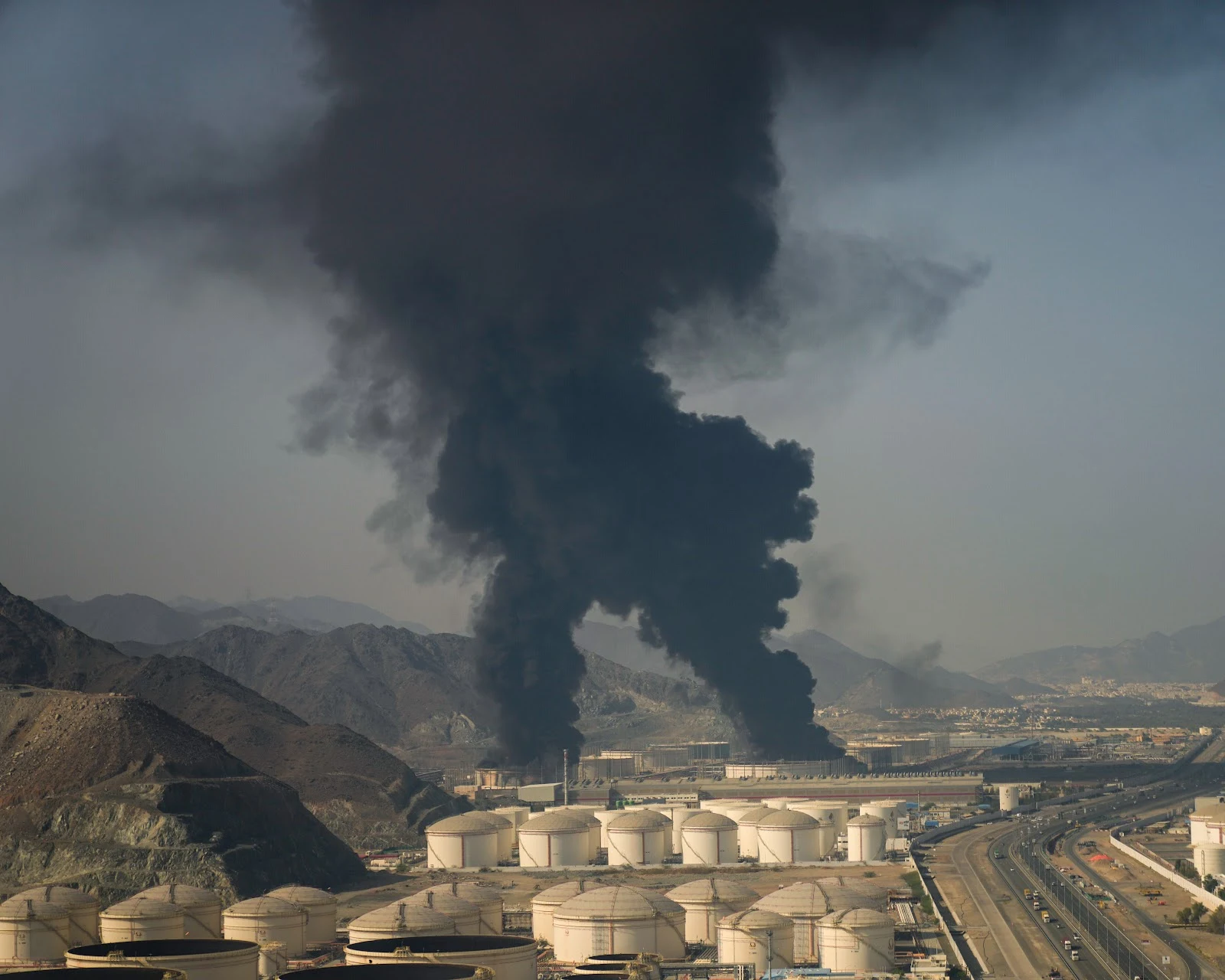
The recent escalation of the Middle East crisis has led to a significant increase in oil and gas prices, with Brent crude climbing 3% to $103.2 (£77.52) a barrel on Tuesday. This surge comes after Iran carried out attacks on production facilities for the first time since the start of the war with the US and Israel, as reported by The Guardian. The international benchmark oil price has risen nearly 50% from levels before the war began on 28 February.
The United Arab Emirates (UAE) has been severely impacted, with a drone striking the Shah natural gasfield, one of the largest in the world, and setting it on fire. Operations at the gasfield remain suspended while officials assess the damage. An oilfield in Iraq, Majnoon, and the UAE's biggest port and oil storage facility, Fujairah, were also hit by Iranian drones and missiles.
The attacks have caused significant disruptions to oil and gas supplies, with the UAE's daily crude oil output more than halving since the conflict started. The country's other export hubs are located within the Gulf, which has been effectively cut off from the world by Iran's control of the Strait of Hormuz. This narrow waterway between Iran and Oman is a critical passage for oil shipments and gas supplies, with a fifth of the world's oil shipments and a fifth of gas supplies passing through it in normal times.
Regional Impacts
Gulf Arab states, including the UAE, have faced over 2,000 missile and drone attacks since the start of the US-Israeli war on Iran. The Iranian foreign minister, Abbas Araghchi, has denied reports of contact with Donald Trump's special envoy Steve Witkoff. The price of Brent crude remains well below the peak of $119.50 a barrel hit during the war.
Analysts at Goldman Sachs have noted that the largest oil market shock on record will have a bigger impact on products such as jet fuel and diesel than on crude. According to Bloomberg, analysts Yulia Zhestkova Grigsby and Daan Struyven stated that "prices have rallied much more for many refined products than for crude." The severe disruptions seen in supplies of medium-heavy crude put the production of diesel, jet fuel, and fuel oil at risk.
Global Consequences
Saul Kavonic, the head of energy research at MST Marquee, said that "mixed messages are coming from the Trump administration on the war's duration, as the market focuses more on the actions on the ground that remain escalatory." The crisis has led to blackouts in Asian countries, with a shift to coal, as most of the oil and gas flowing through the Strait of Hormuz normally goes to Asia.
Sri Lanka has declared every Wednesday a holiday for public institutions to conserve fuel, with President Anura Kumara Dissanayake stating that "we must prepare for the worst but hope for the best." Bangladesh has brought forward Ramadan holidays in universities and introduced planned blackouts across the nation to conserve energy. In Thailand, the government has asked civil servants to wear short-sleeved shirts rather than suits to reduce reliance on air conditioning and to take the stairs instead of lifts.
Expert Analysis
As the Middle East crisis deepens, the impact on the global economy and energy markets will continue to be felt. The situation remains volatile, with the potential for further disruptions to oil and gas supplies. According to experts, the market will continue to focus on the actions on the ground, and the mixed messages from the Trump administration will likely lead to further uncertainty.
