

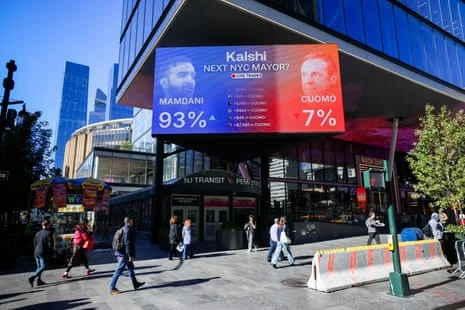
The prediction market industry is facing a significant challenge as two key senators introduced legislation that could limit its growth. Kalshi and Polymarket, the two biggest prediction market sites, have rushed to institute new industry guardrails and add new surveillance tools in response to the proposed bill.
According to a statement from Kalshi, the company will ban political candidates from trading on their own campaigns and pre-emptively block anyone involved in college or professional sports from trading contracts related to the sports they play or are employed by. This move is seen as an attempt to demonstrate the company's commitment to safe markets, as stated by a Kalshi spokesperson.
Polymarket has also instituted its own set of bans, rewriting its rules to clearly state that users cannot trade on contracts where they might possess confidential information or could influence the outcome of an event. Neal Kumar, Polymarket's chief legal officer, stated that these rule enhancements make the company's expectations clear for every participant across both platforms.
Industry Criticism and Regulatory Challenges
Polymarket has faced intense criticism after some of its users made substantial bets ahead of the US-Israel war in Iran and the US's military action in Venezuela earlier this year. Those users appeared to have profited handsomely from knowing in advance that Donald Trump was going to take military action in those regions.
Senators Adam Schiff and John Curtis introduced the "Prediction Markets are Gambling act" on Monday, which would ban prediction markets from creating contracts related to sports. While prediction markets allow users to bet on everything from the weather to political events, much of their recent growth has been in sporting events.
The bill, if enacted, would substantially destroy much of Kalshi and Polymarket's future business prospects. Both companies have signed business deals with several sports teams and leagues to bolster their credibility with sports fans.
State-Level Regulations and Industry Impact
Curtis's home state of Utah has been particularly aggressive in trying to keep Kalshi and Polymarket out of its state. Spencer Cox, Utah's governor, recently signed legislation that would expand the state's definition of gambling to include what are known as "prop bets".
Shares of DraftKings and the parent company of FanDuel, the largest sports betting company in the world, rose sharply on Monday after the senators' announcement. While Schiff and Curtis are not the first politicians to propose a broad ban on the activities of prediction markets, the fact that both political parties are becoming skeptical of them is a cause of alarm for the industry.
Kalshi and Polymarket have found backing from the Trump-controlled Commodity Futures Trading Commission, the federal regulator of derivatives and other prediction markets activities. Michael Selig, the CFTC's chair, has said he would back Kalshi in any of its legal battles at the state level, arguing that federal law pre-empts any state law on this issue.
Investments and Potential Conflicts of Interest
Any friendly decision the CFTC makes on this industry could end up financially benefiting the president's family as well. Donald Trump Jr, the president's son, has invested in Polymarket through his venture capital firm and is a strategic adviser for Kalshi.
As the prediction market industry faces an uncertain future, it remains to be seen how the proposed legislation will impact the growth and development of Kalshi and Polymarket. The introduction of new industry guardrails and surveillance tools may help to address concerns around insider trading and market manipulation, but the outcome of the legislative process will ultimately determine the fate of the industry.
