

**The War that Won't End: Trump's Mixed Messages on Iran and the Uncertain Future of the Conflict**
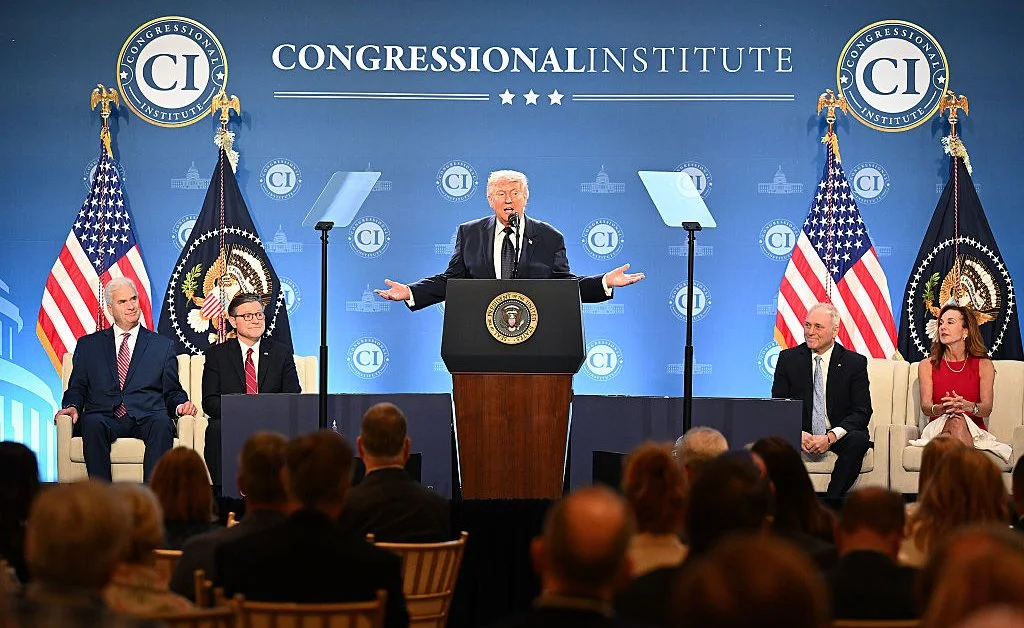
As President Donald Trump addressed Republican lawmakers in Florida on Monday, a sense of unease settled over the country. The war with Iran, now days into its second week, has expanded rapidly across the Middle East, raising fears in Washington that it could deepen into a longer and deadlier conflict. Amidst the chaos, Trump delivered a starkly contrasting narrative, first suggesting that the war was all but over, and then vowing to press forward until Iran's leadership was decisively defeated.
"We've already won in many ways, but we haven't won enough," Trump told the crowd, which responded with applause. "We go forward more determined than ever to achieve ultimate victory that will end this long-running danger once and for all." But his words were at odds with a stark reality: the conflict has already produced a widening humanitarian and economic toll across the region, with over 1,300 people killed in strikes inside Iran and more than 30 dead in Iranian attacks across the Middle East.
**A War with No End in Sight**
The mixed signals from the President underscored the uncertain trajectory of a conflict that has left many questioning the Administration's goals and expected duration. On Monday, the Defense Department posted a message on social media declaring, "We have only just begun to fight." The comments reflected an Administration still struggling to define both the goals and the expected duration of a war that has been shrouded in mystery since its inception.
"It's a short-term excursion," Trump said, reiterating a claim he has made repeatedly. "We're crushing the enemy in an overwhelming display of technical skill and military force." But the war has already taken its toll on civilians, with hundreds of thousands displaced and a growing humanitarian crisis unfolding in Lebanon. "We're going to have a much safer world as soon as it's finished," Trump said Monday. "It's going to be finished pretty quickly." Yet, as the conflict enters its second week, it remains unclear when or if it will end.
**A Leadership in Transition**
As Iran announced that Mojtaba Khamenei, the son of the slain supreme leader Ayatollah Ali Khamenei, would assume the position, Trump expressed disappointment, saying that he and other U.S. officials "think it's going to lead to just more of the same problem for the country." But the transition in leadership has done little to calm the waters, with the conflict continuing to escalate across the region. In a phone interview with CBS News on Monday afternoon, Trump portrayed the war on Iran as nearly finished, saying, "I think the war is very complete, pretty much."
### **A Shifting Narrative**
Since the conflict began, senior officials have offered a series of shifting explanations for the initial strikes on Iran. At times, they have emphasized Iran's nuclear ambitions, while at others they have cited the need to protect American troops and allies in the region. The Administration's inability to articulate a clear goal or strategy has left many questioning the wisdom of a war that appears to be having little impact on the ground. As Trump's words continue to oscillate between optimism and determination, one thing is clear: the war with Iran is far from over, and its uncertain future remains a source of great concern.
### **A Humanitarian Toll**
The war has already produced a widening humanitarian and economic toll across the region. The Iranian Red Crescent Society has said roughly 1,300 people have been killed in strikes inside the country, while Iranian attacks across the Middle East have killed more than 30 people. Israeli strikes have also expanded into Lebanon, killing nearly 500 people, according to the Lebanese officials, and displacing hundreds of thousands of civilians. As the conflict continues to escalate, the humanitarian toll is likely to grow, threatening the very fabric of life in the region.
### **A Policy Debate**
As the Administration struggles to articulate a clear goal or strategy for the war, a growing debate is emerging over the wisdom of the conflict. Some argue that the war is necessary to counter Iran's nuclear ambitions, while others say that it is a reckless and unnecessary escalation of a conflict that has already taken a devastating toll on civilians. As the war continues to unfold, one thing is clear: the Administration's policy on Iran is in disarray, and the uncertain future of the conflict remains a source of great concern.
### **What Comes Next**
As the conflict continues to escalate, one thing is clear: the war with Iran is far from over, and its uncertain future remains a source of great concern. The Administration's inability to articulate a clear goal or strategy has left many questioning the wisdom of a war that appears to be having little impact on the ground. As Trump's words continue to oscillate between optimism and determination, the humanitarian toll of the conflict is likely to grow, threatening the very fabric of life in the region.
