

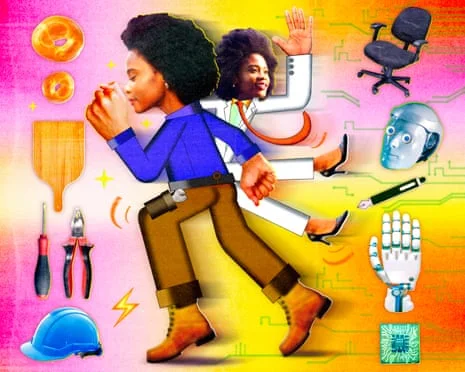
The rise of artificial intelligence (AI) is transforming the job market, with many white-collar workers facing an uncertain future. As AI job losses increase in the professional sector, some individuals are switching to more traditional trades, while others are retraining in new fields. According to a 2023 report by the Department for Education, professional occupations are more exposed to AI, particularly those associated with clerical work and roles in finance, law, and business management.
For Jacqueline Bowman, a 30-year-old writer from California, the shift towards AI has been a challenging experience. After studying journalism at university, Bowman worked as a freelance writer, but found that her work "kind of dried up" in 2024 due to layoffs and publication closures. She was offered work as an editor, checking and altering content produced by AI, but found that the job was time-consuming and poorly paid. Bowman has now decided to retrain as a marriage and family therapist, a career she believes is "not AI-proof" but still has an audience who wants human interaction.
Janet Feenstra, an academic editor turned baker based in Malmö, Sweden, has also made a significant career change due to AI. Feenstra, 52, had been working as a freelance editor alongside a part-time job at Malmö University, but began to hear people talking about using AI and felt that her job was at risk. She decided to retrain in culinary school and now works in a bakery, enjoying the physicality of the job but acknowledging that it is a more tiring and lower-paid role than her previous career.
Career Shifts and Academic Perspectives
Angela Joyce, the CEO of Capital City College, a further education provider in London, notes that there is a steady growth in students of all ages coming to study trades-based qualifications, such as engineering, culinary arts, and childcare. This shift towards vocational training is, in part, linked to AI, as people seek jobs that are less likely to be automated. Richard, a 39-year-old chartered occupational health and safety professional from Northampton, has also made a career change, retraining as an electrical engineer due to concerns about the impact of AI on his previous role.
Carl Benedikt Frey, an associate professor of AI and work at the Oxford Internet Institute, agrees that manual work is harder to automate, but predicts that AI will have an impact across a wide range of industries. Frey suggests that becoming skilled at working with AI will be a valuable asset in the future job market. Dr. Bouke Klein Teeselink, who authored a study on the impact of AI on the job market in the UK, notes that while AI may replace some jobs, it is unlikely to lead to mass unemployment, as new jobs will be created to replace those that are lost.
Personal Accounts and Labour Market Data
For some individuals, the rise of AI has meant giving up on their dream career. Paola Adeitan, 31, had planned to become a solicitor but decided not to pursue that path due to concerns about the impact of AI on the legal profession. Adeitan now works in the health sector, but is remaining open to the idea of retraining again. Faz, 23, has also made a career change, switching from a geography degree to training as an electrician, due to concerns about the impact of AI on entry-level roles in the corporate sector.
Bethan, 24, from Bristol, has experienced the negative impact of AI on her career, losing her job at a university IT helpdesk due to the introduction of an AI kiosk. She now works in a cafe, but is struggling to find an office job due to the lack of entry-level roles. The electricians Richard works with are typically younger and more able to withstand the physical demands of the job, highlighting the challenges faced by older workers who are switching to more physically demanding roles.
Expert Analysis and Future Implications
While some experts, like Frey, advise against panicking about the impact of AI on the job market, others, like Klein, note that the value of expertise may actually increase as AI becomes more prevalent. The development of expertise, however, may be hindered by the lack of entry-level jobs, as AI systems replace human workers. As the job market continues to evolve, it is clear that workers will need to adapt and develop new skills to remain relevant.
The future of work is uncertain, but one thing is clear: the rise of AI is transforming the job market, and workers must be prepared to adapt. As Feenstra notes, "I want my sons to feel a little bit inspired by that," highlighting the importance of being able to adapt to change and find new career paths. While the impact of AI on the job market is still unfolding, it is essential to consider the implications for workers, businesses, and society as a whole.
