

**The Unending War: Trump's Mixed Signals on Iran**
As the war with Iran entered its second week, President Donald Trump delivered a contradictory message, suggesting that the conflict could be nearing its end, even as he vowed to continue pressing forward until Iran's leadership was decisively defeated. In a day of interviews and speeches, Trump portrayed the war as "very complete" and "short-term," while also pledging continued military pressure against the regime.
For Chasity Jackson, a nurse from Doral, Florida, who had been following the conflict with growing alarm, Trump's words brought little comfort. "It's like he's trying to tell two different stories at once," she said, shaking her head. "I don't know what to believe anymore." As a nurse, Jackson has seen firsthand the human toll of the war, from the families displaced by airstrikes to the countless wounded seeking treatment at local hospitals.
The mixed signals from the President underscored the uncertain trajectory of a conflict that has expanded rapidly across the Middle East, raising fears in Washington that it could deepen into a longer and deadlier war. In a phone interview with CBS News, Trump portrayed the war on Iran as nearly finished. "I think the war is very complete, pretty much," the President said from his golf club in Doral, Fla., arguing that Iran's military capabilities had been largely destroyed after a wave of strikes by the United States and Israel.
**A War of Contradictions**
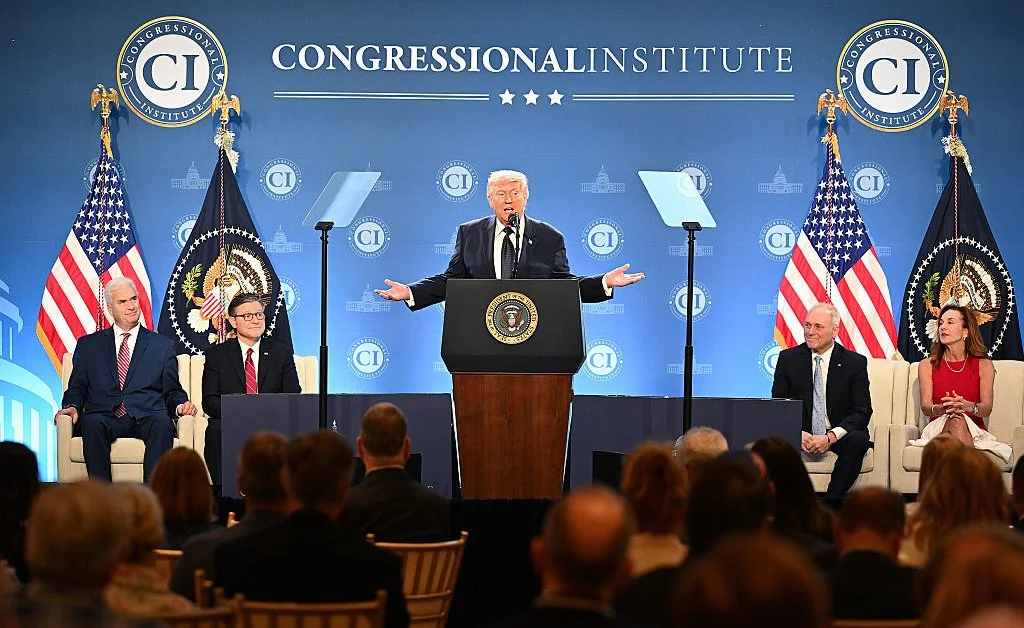
But hours later, speaking to Republican lawmakers gathered for a House policy retreat in Florida, Trump struck a very different tone, describing the war as unfinished and pledging continued military pressure. "We've already won in many ways, but we haven't won enough," Trump told the crowd, which responded with applause. He added that the United States would not stop until Iran's leadership and military apparatus were fully defeated. "Now nobody has any idea who the people are that are going to be the head of the country," Trump said, after Iran announced that Mojtaba Khamenei, the son of the slain supreme leader Ayatollah Ali Khamenei, would assume the position.
The comments reflected an Administration still struggling to define both the goals and the expected duration of a war now days into its second week. Since the conflict began, senior officials have offered a series of shifting explanations for the initial strikes on Iran—at times emphasizing Iran's nuclear ambitions, at other moments citing the need to protect American troops and allies in the region, or pointing to Israel's own military plans.
**A Widening Humanitarian Toll**
The war has already produced a widening humanitarian and economic toll across the region. The Iranian Red Crescent Society has said roughly 1,300 people have been killed in strikes inside the country, while Iranian attacks across the Middle East have killed more than 30 people. Israeli strikes have also expanded into Lebanon, killing nearly 500 people, according to the Lebanese officials, and displacing hundreds of thousands of civilians. "We're going to have a much safer world as soon as it's finished," Trump said Monday. "It's going to be finished pretty quickly."
As the war continues to unfold, one thing is clear: the consequences of this conflict will be far-reaching, with the potential to reshape the geo-politics of the Middle East for years to come. For now, President Trump's mixed signals only add to the uncertainty, leaving many to wonder: what does the future hold for this war, and for the people caught in its crossfire?
