

**The Shifting Frontlines of War: Trump's Contradictory Signals on Iran**
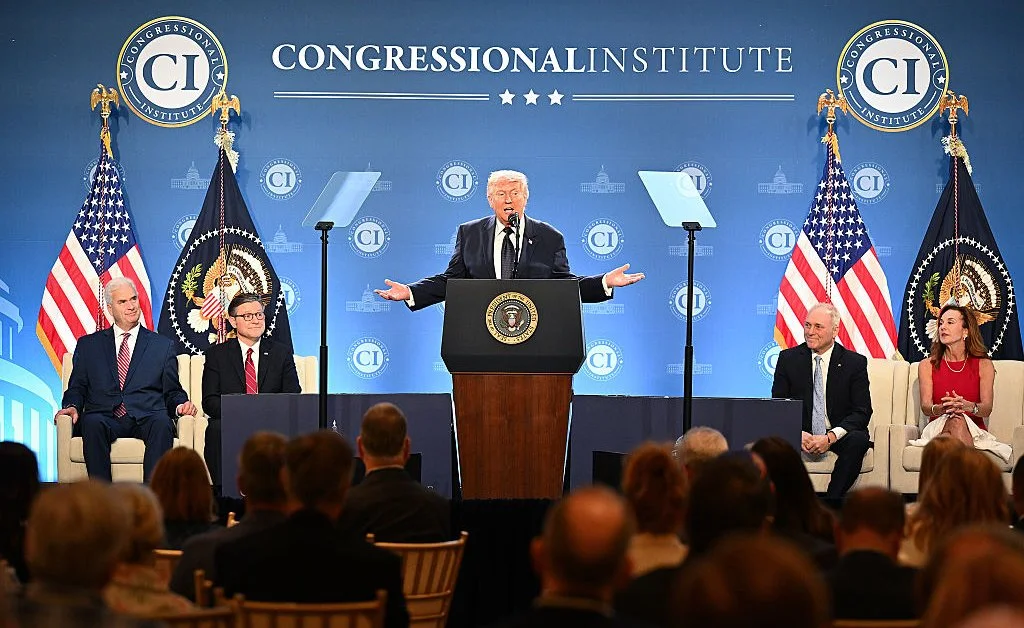
As President Donald Trump stood before a crowd of Republican lawmakers in Florida on Monday, he proclaimed, "We've already won in many ways, but we haven't won enough." His words encapsulated the uncertain trajectory of a conflict that has expanded rapidly across the Middle East and raised fears in Washington that it could deepen into a longer and deadlier war.
For weeks, the United States and its allies have been engaged in a military campaign against Iran, with airstrikes and missile launches aimed at crippling the country's military infrastructure. However, the Administration's goals and expected duration of the war have been in a state of flux, with senior officials offering shifting explanations for the initial strikes.
In a phone interview with CBS News, Trump portrayed the war on Iran as nearly finished, saying, "I think the war is very complete, pretty much." He argued that Iran's military capabilities had been largely destroyed after a wave of strikes by the United States and Israel. "If you look, they have nothing left. There's nothing left in a military sense," he said.
But hours later, speaking to Republican lawmakers, Trump struck a very different tone, describing the war as unfinished and pledging continued military pressure. "We go forward more determined than ever to achieve ultimate victory that will end this long-running danger once and for all," he said. The President added that the United States would not stop until Iran's leadership and military apparatus were fully defeated.
The mixed signals from the President underscored the uncertainty surrounding a conflict that has already produced a widening humanitarian and economic toll across the region. The Iranian Red Crescent Society has said roughly 1,300 people have been killed in strikes inside the country, while Iranian attacks across the Middle East have killed more than 30 people. Israeli strikes have also expanded into Lebanon, killing nearly 500 people, according to the Lebanese officials, and displacing hundreds of thousands of civilians.
As the war continues to unfold, the Administration's messaging has been characterized by internal contradictions. Secretary of State Marco Rubio initially suggested that the United States moved in part because Israel was preparing its own attack and might have triggered retaliation against American forces. Trump later rejected that framing, saying he believed Iran itself was preparing to strike first and that he might have "forced Israel's hand."
The conflicting signals have sparked concern that the war may be escalating into a longer and deadlier conflict. The Pentagon's own messaging has reflected this uncertainty, with a message posted on social media on Monday declaring, "We have only just begun to fight."
As Trump touted the progress of the war, he also repeatedly called it a "short-term excursion," saying that the United States had gone into the region "to get rid of some evil" and predicting that the campaign would end quickly. "Together with our Israeli partners, we're crushing the enemy in an overwhelming display of technical skill and military force," he said. "Iran's drone and missile capability is being utterly demolished. The Navy is gone. It's all lying at the bottom of the ocean. 46 ships. Can you believe it?" He added that the U.S. "got rid of about 80% of" Iran's missile launchers.
The comments reflected the President's efforts to present a narrative of progress, even as the war continues to unfold. However, the contradictions in his messaging have underscored the uncertainty surrounding the conflict and raised questions about the Administration's strategy and goals.
**A Wider Humanitarian Toll**
The conflict has already produced a widening humanitarian and economic toll across the region. The Iranian Red Crescent Society has said roughly 1,300 people have been killed in strikes inside the country, while Iranian attacks across the Middle East have killed more than 30 people. Israeli strikes have also expanded into Lebanon, killing nearly 500 people, according to the Lebanese officials, and displacing hundreds of thousands of civilians.
The displacement of civilians has been a major concern, with many families forced to flee their homes and seek refuge in neighboring countries. The economic toll of the war has also been significant, with the closure of key shipping lanes and ports disrupting trade and commerce across the region.
**A Shifting Landscape**
As the war continues to unfold, the Administration's messaging has been characterized by internal contradictions. The conflicting signals have sparked concern that the war may be escalating into a longer and deadlier conflict. The Pentagon's own messaging has reflected this uncertainty, with a message posted on social media on Monday declaring, "We have only just begun to fight."
The conflicting signals have also raised questions about the Administration's strategy and goals. Has the United States gone into the region to achieve a specific objective, or is the war simply a response to Iran's military provocations? The answers to these questions remain unclear, even as the conflict continues to unfold.
**A Broader Shift**
The war in Iran is part of a broader shift in the global balance of power. As the United States continues to engage with its allies in the Middle East, the conflict has highlighted the country's military capabilities and its willingness to use force in pursuit of its goals.
However, the contradictions in the Administration's messaging have also underscored the uncertainty surrounding the conflict. The war has already produced a widening humanitarian and economic toll across the region, and the consequences of the conflict remain uncertain.
**A Challenging Road Ahead**
As the war continues to unfold, the Administration's messaging will be critical in shaping public opinion and influencing the trajectory of the conflict. However, the contradictions in the President's statements have already sparked concern that the war may be escalating into a longer and deadlier conflict.
The consequences of the conflict remain uncertain, and the Administration's strategy and goals remain unclear. The human toll of the war will continue to grow, and the economic consequences will be significant. As the war continues to unfold, the Administration will face increasing pressure to clarify its goals and provide a clear strategy for ending the conflict.
