

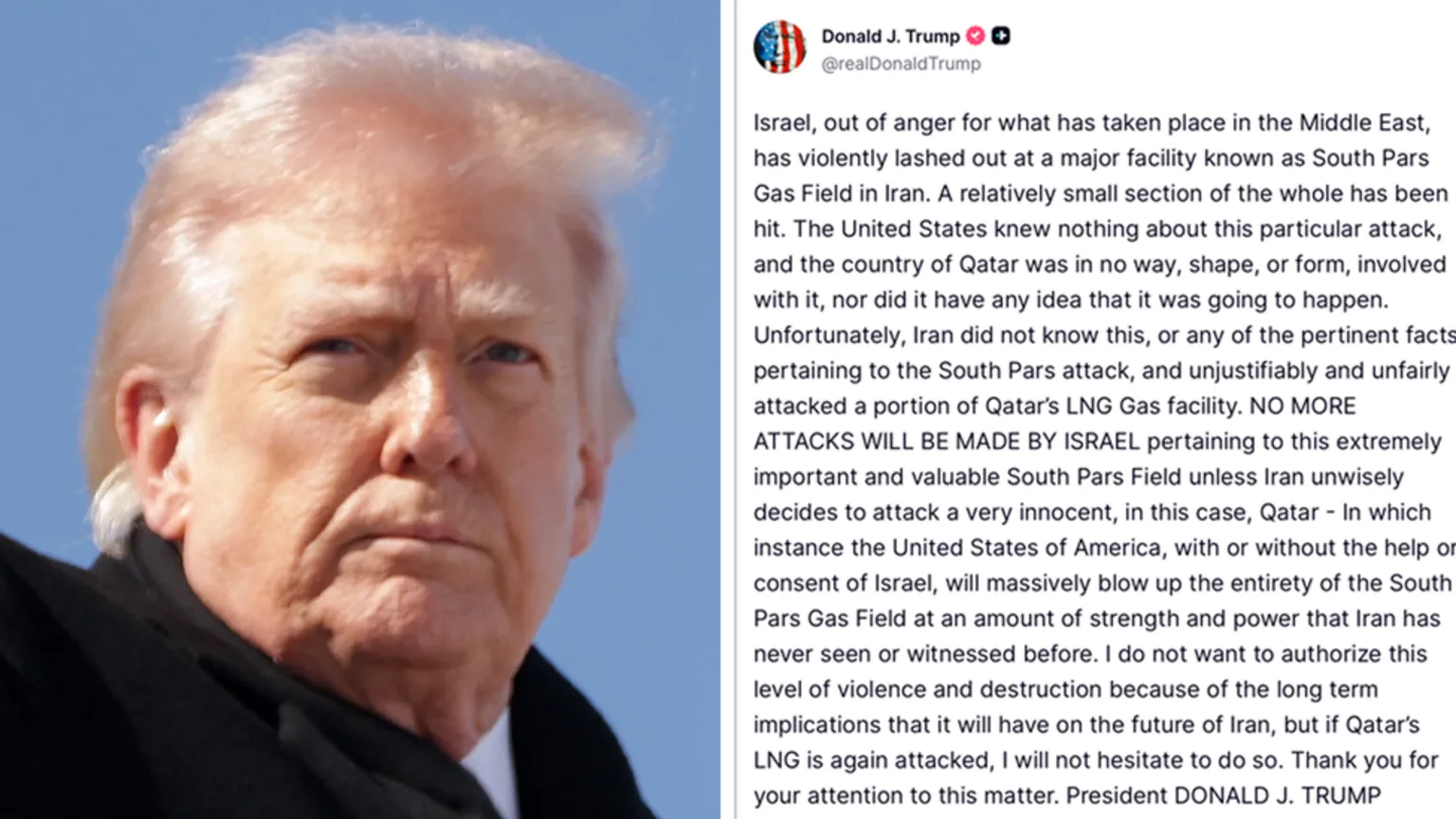
US President Donald Trump issued a statement in response to attacks on a major gas field shared by Iran and Qatar on Wednesday.
According to reports, Israel hit Iran's South Pars, part of the world's largest natural gas field, and Tehran retaliated by striking an energy complex in Qatar.
The attacks led to a spike in energy prices, prompting Trump to threaten Iran and express his frustration, as reported by the BBC and other media outlets.
Timeline of Events
On his Truth Social media platform, Trump stated that the US "knew nothing about this particular attack", contradicting reports in Israeli newspapers, including Yedioth Ahronoth and Israel Hayom.
These reports suggested that the attack was coordinated in advance with the United States and agreed upon between Prime Minister Benjamin Netanyahu and US President Trump.
US-Israel Alignment
Alex Gandler, spokesman for the Israeli embassy in London, told the BBC that the two countries are "very much aligned on most or all of our goals regarding the Islamic regime in Iran".
However, Israeli officials have been more consistent in their desire to see regime change in Iran, with Prime Minister Netanyahu making no secret of his decades-long desire to topple the Islamic regime.
Response to Attacks
Trump warned that if Iran attacks Qatar's LNG facilities again, the US "with or without the help or consent of Israel, will massively blow up the entirety of the South Pars Gas Field".
The reference to Israeli consent for threatened action has raised questions about the level of coordination between the two countries.
Global Implications
The conflict has led to a spike of more than 25% in gas prices in Europe, and analysts fear that the disruption to supply could continue for longer than initially thought.
The attacks have also raised concerns about the impact on oil and gas prices, household energy bills, and food costs, with lawmakers pressing intelligence officials about the Iran war and its potential consequences.
